THE AI RACE / REPORTED TALKS
Nvidia–Reflection AI talks: why the open-model race matters
A reported deal discussion puts a bigger question in focus: who will control the chips, models and tools behind the next wave of AI?

On 10 October, Reuters relayed a Financial Times report that Nvidia was discussing a larger investment in Reflection AI or a purchase. That is a report of talks, not confirmation of an acquisition. The story matters because Reflection is developing open-weight AI: models intended to give developers more control over how they run and adapt them.
What is actually known about the talks?
Reuters’ 10 October report, citing the Financial Times, describes early discussions. Possible structures included further investment, an acquisition, or hiring staff and licensing technology. The discussions could fail. Reuters said it had not independently verified the report.
No completed transaction is established by the sources used for this article. We have not obtained direct comment from either company. Treat headlines saying Nvidia “has bought” Reflection as going beyond this evidence.
Investment
Money goes into a company. A stake alone does not tell you who controls it.
Acquisition
A buyer takes ownership under agreed terms. Talks are only an earlier stage.
Team + technology
Hiring people and licensing their work can differ from buying the entire company.
General explanations of the reported possibilities; none is an announced outcome.
Who are the researchers behind Reflection?
Reflection’s co-founders are Misha Laskin and Ioannis Antonoglou. In Alex Heath’s 5 October interview, Laskin is identified as CEO and a former leader of Gemini reward modelling at DeepMind. Antonoglou, the CTO, helped develop AlphaGo and AlphaZero and later led Gemini’s reinforcement learning from human feedback work.
That background connects Reflection to two different AI traditions: systems that learn from feedback, and systems that perform complex reasoning tasks. It helps explain why the company attracts attention. It does not prove that a new model will outperform its competitors.
The same interview describes the founders’ plan to build a business around deploying and operating open models. Giving access to a model and charging for the surrounding infrastructure are compatible ideas: the model can be one part of a larger service.
What is Beam, and why is everyone saying “open-weight”?
Reflection announced Beam on 5 October. This is background to the newer talks report, not a model launch that happened today. Reflection describes it as a text model for coding, reasoning and agent tasks, with 501 billion total parameters and 23 billion active parameters.
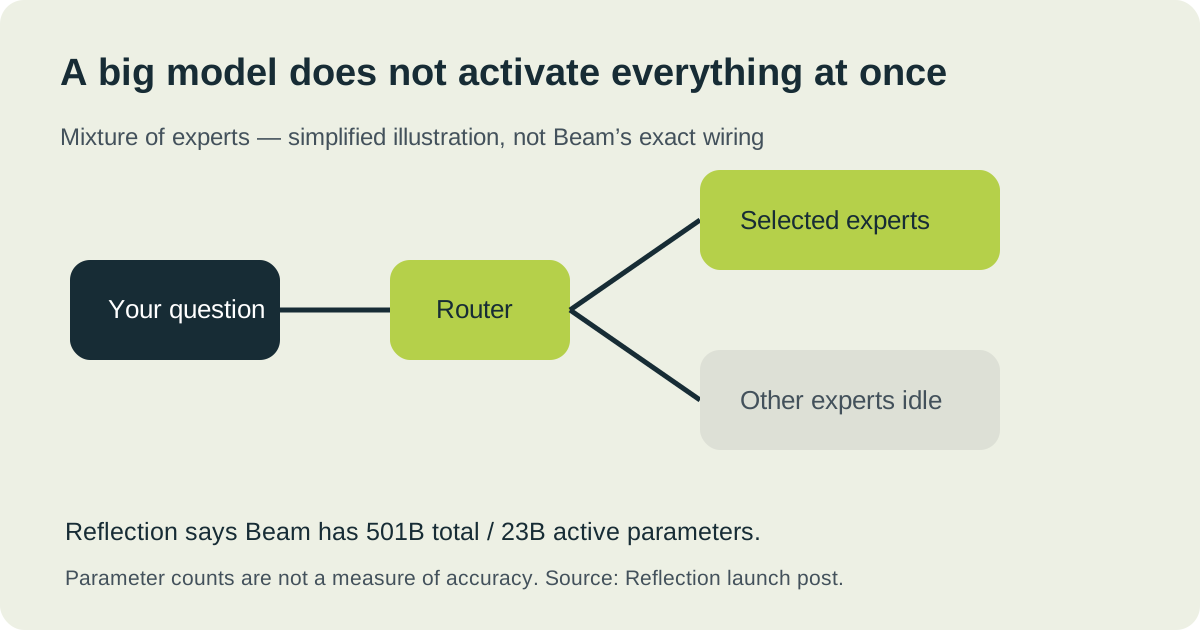
Parameters are learned numerical values inside a model. A mixture-of-experts system selects parts of the model for a given input instead of activating everything. Think of a large organisation calling the relevant specialists into a meeting. That is an analogy, not a literal description of how the model thinks.
Open weights give people access to those trained values under a licence. They do not necessarily include the complete training data or every step used to build the system. “Open-weight” and “fully open-source” should not be used interchangeably without checking what is released.
Reflection’s launch page says it plans to release the weights under Apache 2.0 later in October, after final testing. It describes early access for selected users. An announcement of an intended release is not proof that a public download is already available.
Here is the original public post—not a recreated tweet

The distinction matters: a model announcement, an interview and a reported transaction are different pieces of evidence. Linking them can provide context. Combining them into a claim that a deal is complete would be misleading.
What about claims that Beam is much cheaper?
Reflection says its reasoning comparisons use less inference compute than selected competing models. Its launch page explains that these are estimates and exclude some serving costs. We have not independently reproduced those tests. Less estimated compute does not automatically mean a lower price for every user or better answers on every task.
For a fair comparison, ask whether models were tested with the same tools, settings and tasks. Then check quality, latency, hardware requirements and total operating cost. A single attractive benchmark cannot answer all of those questions.
Why does this story matter beyond Nvidia?
Our analysis: The interesting issue is the relationship between the machine that runs AI and the model running on it. A closer relationship could help engineers improve deployment. It could also make developers ask whether an ostensibly open model remains convenient across different platforms. Neither outcome follows automatically from the reported talks.
For researchers, accessible weights can make it easier to study behaviour and test adaptations. For developers, they can offer more control over deployment. For ordinary users, the eventual benefit would depend on what developers build: access alone does not produce reliable applications.
There is also a safety trade-off. More access can enable more scrutiny, but it can give harmful actors more opportunities to adapt a system. The answer depends on actual capabilities, licences, deployment controls and safeguards—not simply the word “open.”
What are people discussing online?
A public r/LocalLLaMA discussion shows users debating the reported talks and what closer ties might mean for the open-model ecosystem. These are individual opinions, not a poll or evidence that a deal will happen. We are linking the discussion rather than treating its speculation as reporting.
What should readers watch next?
- A direct company announcement. This would be stronger evidence of a transaction than repeated versions of the same sourced report.
- An actual weights release. Look for downloadable files, licence terms and documentation.
- Independent testing. Prefer reproducible comparisons to a launch-day ranking.
- Deployment details. Check the hardware, costs and restrictions that affect real use.
Quick answers
Has Nvidia bought Reflection AI?
That is not established by the sources checked here. The recent report describes talks.
Is Beam a new release today?
No. Its announcement is dated 5 October. The newer news hook is the 10 October talks report.
Does a bigger parameter count mean better AI?
No. Architecture, training, evaluation and the task all matter.
Does open-weight mean anyone can run it on a phone?
No. Access rights and hardware requirements are different questions.
Sources, dates and transparency
Reuters, 10 October: reported talks citing FT · Reflection, 5 October: Beam announcement · Sources interview, 5 October: founders’ background and views · Original X announcement · Public discussion.
Sources checked on 12 October 2026. AI assisted research, drafting and the labelled cover illustration. The screenshot is an authentic excerpt. Technical graphics are original explanatory diagrams. No paid promotion is included in this article.