AI / WORK / PUBLIC OPINION
Will AI take jobs? A new U.S. survey shows fear—and willingness to learn
People can welcome useful tools while worrying about what those tools mean for their future. The numbers explain that tension, with an important limit: opinions are not forecasts.
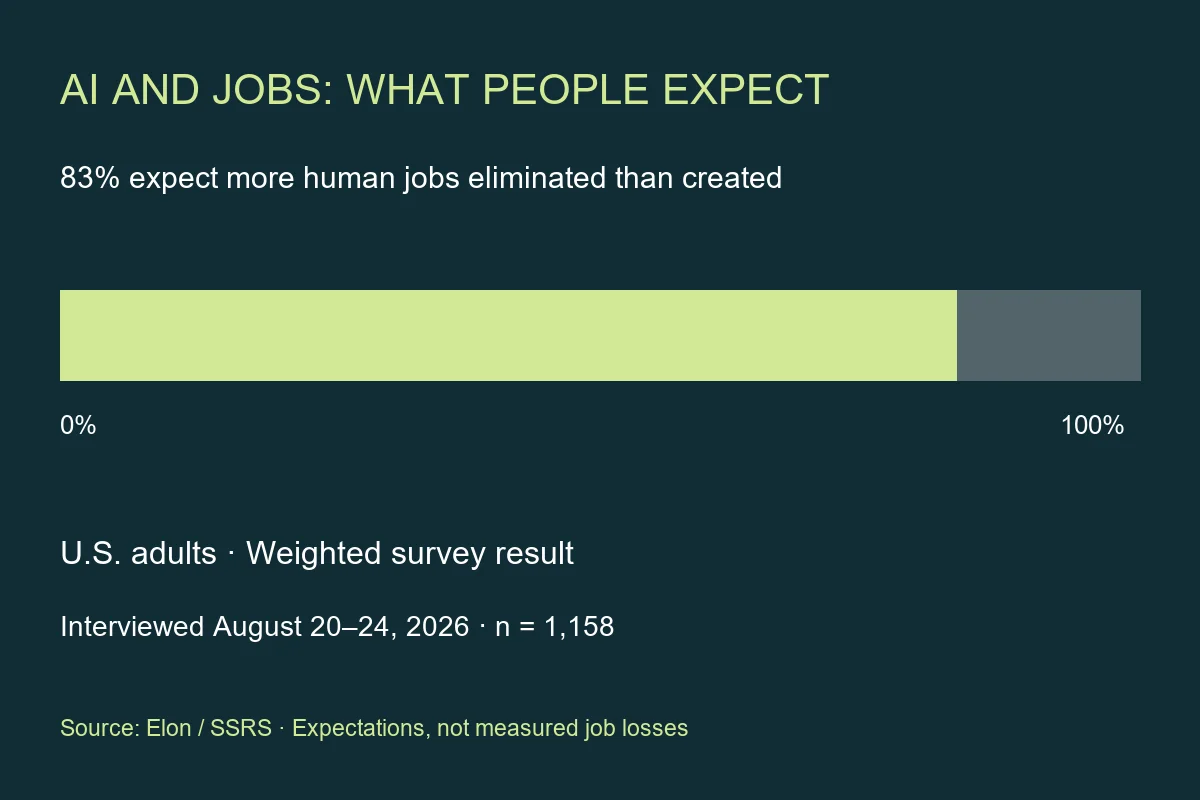
Elon University highlighted a national survey on 13 October: 83% of U.S. adults expect AI to remove more human jobs than it creates. Separately, 66% of workers are comfortable using AI at work or open to it with training. Neither number tells us how many jobs AI will actually remove.
What did the survey find?
The university’s news release describes concern about income, control and the purpose people get from work. In the all-adult results, 68% chose the view that most jobs would pay too poorly for a decent lifestyle as businesses adopt AI. Another question found 62% choosing the view that available jobs would become dull and unfulfilling.
Those are responses to questions about the future. They are evidence about people’s expectations at the time of the interviews, rather than measured employment outcomes.
The questions about job quality explicitly asked respondents to choose the closest of two statements even if neither exactly matched their view. That format matters: a large percentage should not be interpreted as support for every possible detail of a sweeping claim.
Why willingness to use AI can coexist with worry
Among employed respondents, 25% said they were already comfortable using AI at work; 41% said they were open to using it with more training. Adding those published categories gives 66%. It does not mean 66% already use AI comfortably.
Half of workers said they were extremely or very confident they could adapt their skills to changing requirements in their current job. The corresponding share confident about controlling their career path was 40%.
Our interpretation: learning a tool and controlling the consequences of its adoption are different things. Someone might welcome help drafting a document while still worrying about staffing decisions. That example illustrates the distinction; it is not a quotation from a participant or proof of a causal relationship.
Who was surveyed—and when?
SSRS conducted the probability-based survey from 20–24 August 2026. It included 1,158 U.S. adults, including an oversample of 150 employed adults. The employed group totalled 775 respondents. Interviews were in English, predominantly online, with some telephone interviews.
The methodology report says results were weighted to represent U.S. adults aged 18 and older. It gives a margin of error of ±3.4 percentage points for the total sample at the 95% confidence level. That full-sample figure should not automatically be attached to smaller subgroups.
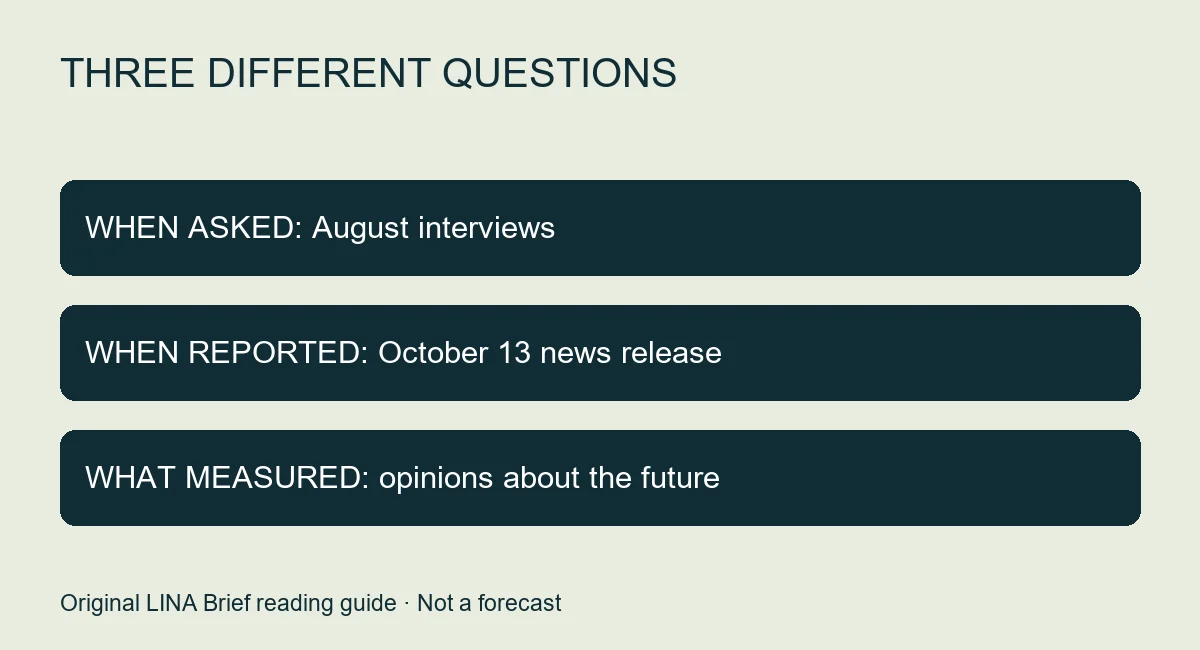
The university article is new today; the interviews happened in August and the methodology document is dated September. Readers should keep those dates separate. This reporting does not establish when every underlying file first became publicly available.
What international readers should take from it
This is a U.S. survey. It does not establish what workers in India or the entire world believe. Labour markets, access to training and institutions differ across countries.
Its useful international question is more specific: what support accompanies adoption? In the worker responses, 52% considered guidance about AI’s limits and when human judgment should take priority extremely or very helpful. Clear, regularly updated AI-use policies received that rating from 49%.
Those responses suggest subjects employers and educators can discuss with their own communities. They do not demonstrate that a particular training programme works, that a job is safe, or that a product improves productivity.
What to watch next
To understand employment effects, look for evidence about actual hiring, task changes, hours and wages. To understand whether training helps, look for evaluations that measure outcomes over time. A public-opinion survey contributes a different piece: how people perceive the transition.
Keep three questions separate when reading an AI headline: What changed? What was measured? What remains uncertain? That habit helps a dramatic percentage become useful information.
Sources and transparency
Checked on 13 October: Elon University release, questionnaire and topline tables, and the linked SSRS methodology. These describe the same study and are not independent replications. AI assisted research and writing. Both visuals are original explanatory graphics; no photos or public-post screenshots are fabricated.
Related: What Meta’s new agent features promise—and what remains untested.
How is AI changing your work? Share your thoughts in the moderated discussion ↓