AI INFRASTRUCTURE / OCP 2026
Nvidia and Meta at OCP 2026: why AI needs faster networks
The next AI race involves the connections between chips, the cooling around them and the designs that let suppliers build compatible equipment.
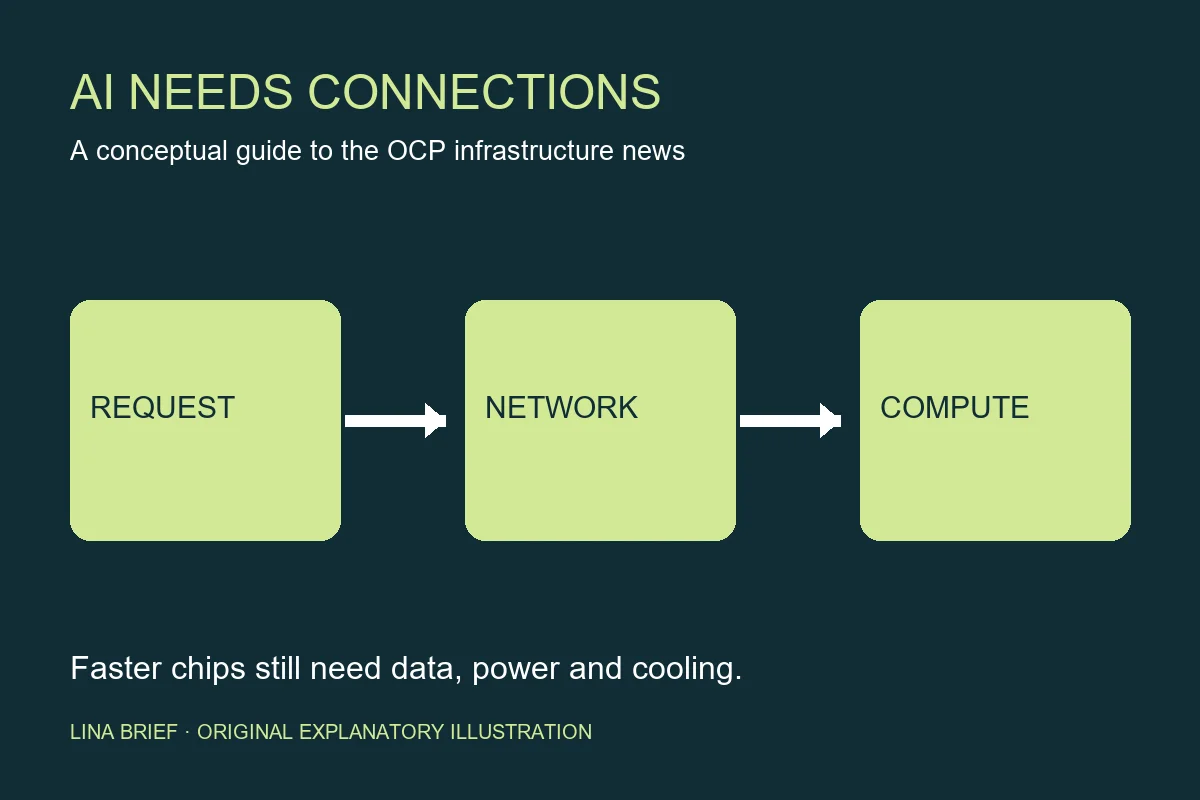
On 12 October, Nvidia announced open rack-design contributions for Vera Rubin infrastructure. Meta described new liquid-cooled networking, and Cisco announced optical-module design plans with Nvidia. The shared issue is simple: powerful chips need to exchange data efficiently. These are infrastructure announcements, not a new chatbot release or proof that your AI app is immediately faster.
What did Nvidia actually announce?
In its 12 October announcement, Nvidia said it contributed Vera Rubin rack and compute-tray designs to the Open Compute Project through its MGX architecture. It describes MGX 1.2 as adding liquid-cooling and power interfaces, modular equipment support and rack designs supporting up to 250kW.
This is openness at the infrastructure-design level. It does not mean every Nvidia chip design is public, every component is free, or AI models running on those machines become open-weight. Those are separate questions with separate licences and requirements.
What are Meta’s IcePack and IceCube?
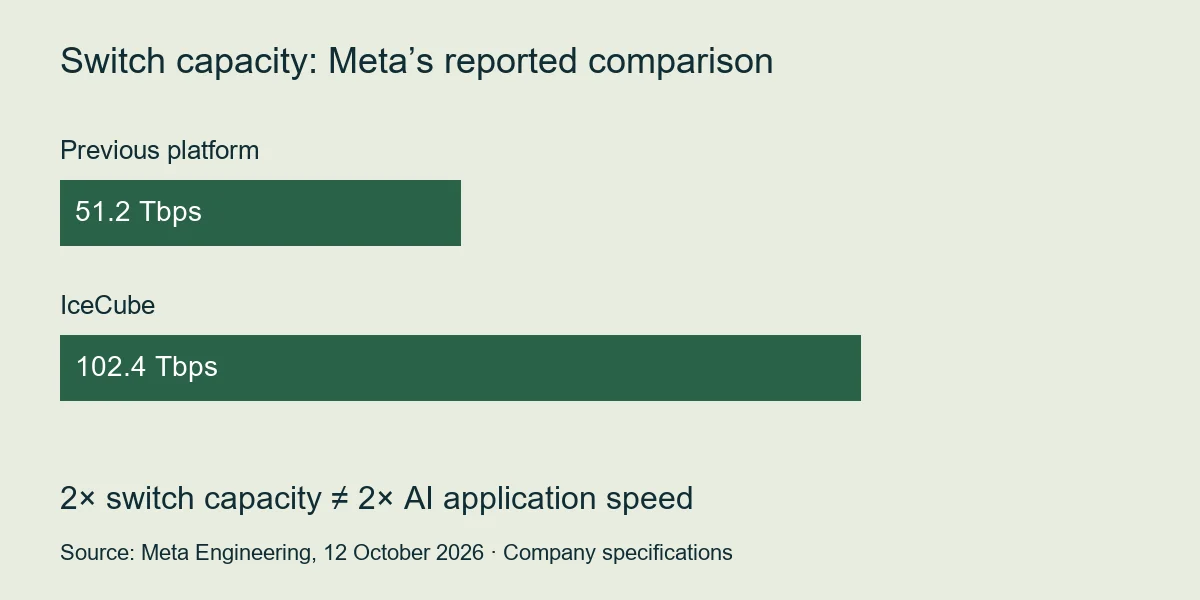
Meta’s engineering team describes IcePack as its first liquid-cooled network rack. IceCube is the switch platform inside it. Meta says the switch blades provide 102.4 terabits per second of capacity, twice its earlier 51.2T platforms. Two variants use different switch chips: Broadcom Tomahawk6C and Nvidia Spectrum-6. Both run Meta’s open-source FBOSS networking software.
That capacity describes the switch, not a person’s broadband connection. It also does not establish that an entire AI model runs twice as fast. The useful result depends on where the system’s bottleneck actually sits.
Why does an AI model need a network?
Think of a group preparing a large report. Each person can work quickly, but the group still needs to exchange drafts, check changes and combine results. If those exchanges are slow, faster individual workers may spend more time waiting.
A large AI workload can similarly spread work across many processors. Data movement, memory, computation and software must fit together. A fast processor cannot solve a delay caused by another part of the system on its own. This analogy explains the engineering problem; it is not a measurement of these new products.
What is Cisco and Nvidia’s USFP proposal?
Cisco says the companies announced design plans for Ultra-Dense Small Form-Factor Pluggable, or USFP. This is a format for replaceable optical networking modules. Cisco describes a design with 16 lanes at 400 gigabits per second per lane, giving 6.4T aggregate capacity, and a path to 32 lanes and 12.8T.
The distinction between a design plan and a product you can buy matters. This announcement does not by itself establish shipping dates, prices or independent field performance. Capacity targets should be read as company-described engineering plans.
Why ordinary readers should care
Our analysis: Infrastructure affects the cost and reliability of running AI services. More compatible equipment could give operators more options when building or maintaining systems. Better connections could reduce waiting when communication is the limiting factor. But savings at a data centre do not automatically become a lower subscription price.
For developers, this is a reminder to measure the whole application. Slow answers can come from model processing, retrieval, external tools, queues or the user’s connection. Buying into a headline specification is less useful than finding the delay that actually affects your users.
What the announcements do not prove
- They do not establish a universal improvement in answer quality.
- They do not show that every workload gains the same speed or efficiency.
- Open interfaces do not eliminate power, cooling, procurement or integration costs.
- Partner announcements corroborate that the collaborations exist; they are not independent performance audits.
Before drawing stronger conclusions, look for shipping documentation, clear test conditions and independent workload measurements. Useful questions include: what was compared, how much power was used, and did the application finish more work?
Quick answers
Is Vera Rubin a new AI model?
No. This story concerns computing infrastructure and rack designs, not a newly released chatbot model.
Does 102.4T mean my internet becomes faster?
No. It describes a data-centre switch’s capacity.
Will AI subscriptions become cheaper?
These announcements do not establish consumer pricing changes.
Sources and transparency
Nvidia announcement, 12 October · Meta engineering announcement, 12 October · Cisco announcement, 12 October.
Checked on 13 October 2026. This article uses original company announcements and separates reported specifications from our explanation. We have not independently tested the hardware. AI assisted research and drafting; visuals are original explanatory graphics. No tweet screenshot is included because this report relies on the original technical announcements.