SPACE SCIENCE / AUTONOMOUS ROBOTICS
Perseverance breaks the Mars driving record: how AutoNav helps it explore
A distance milestone offers a simple way to understand a harder engineering achievement: a robot choosing a safe path on another world.
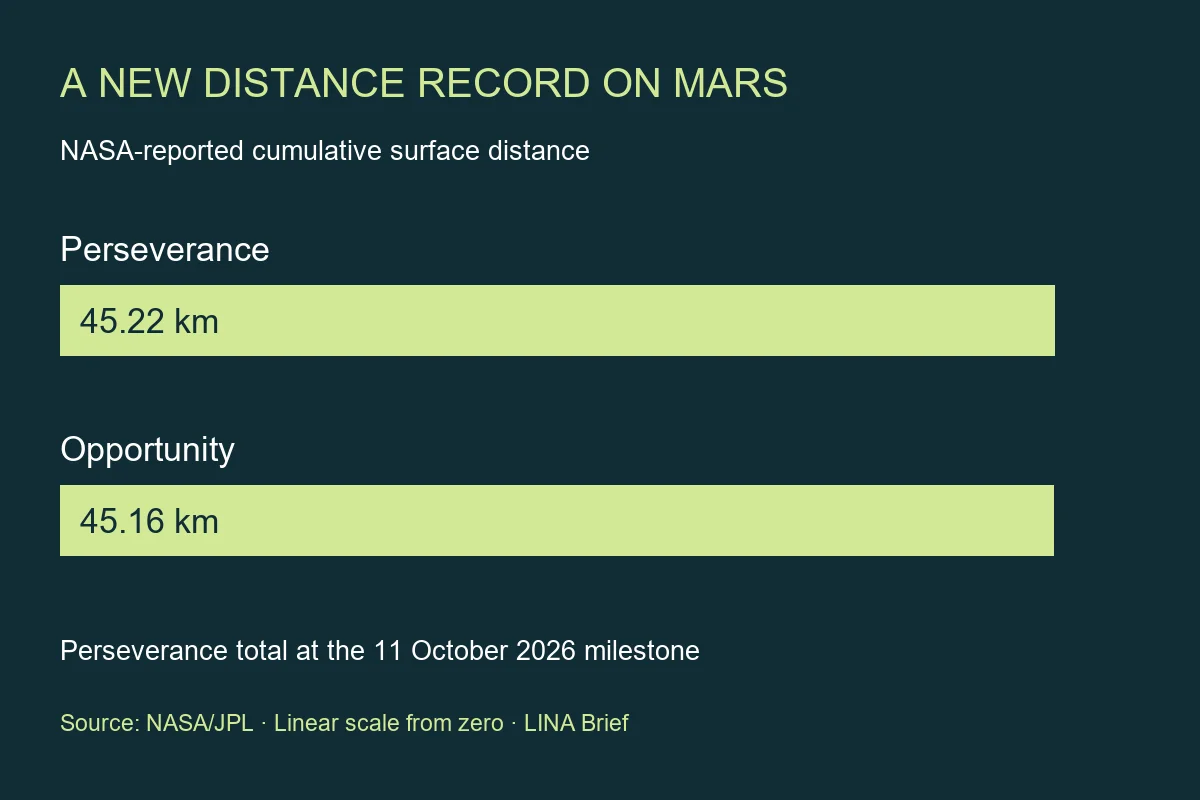
NASA says Perseverance reached 45.22 kilometres on 11 October, passing Opportunity’s 45.16-kilometre record. The announcement arrived on 12 October. The difference is small; the useful story is how autonomous navigation helps a rover reach more places to investigate.
What record did Perseverance break?
NASA’s Jet Propulsion Laboratory reports that Perseverance surpassed the cumulative surface-driving distance of any vehicle on another world. It reached the mark on mission sol 2,006. A sol is a Martian day. These are total distances accumulated over many drives, not a single trip.
Using the rounded kilometre figures NASA gives, the lead is about 60 metres. That calculation is only a comparison of the published totals; it should not be read as an exact measurement of a particular final stretch.
A record headline can make the achievement sound like a race. It is more useful to think of the odometer as a sign of reach. The vehicle still needs to do something valuable at the places it reaches.
How does AutoNav work?
JPL describes AutoNav as taking terrain images while the rover moves, constructing a three-dimensional hazard map and choosing a course between waypoints selected by planners on Earth. The agency says more than 90% of Perseverance’s travelled distance used AutoNav terrain evaluation.
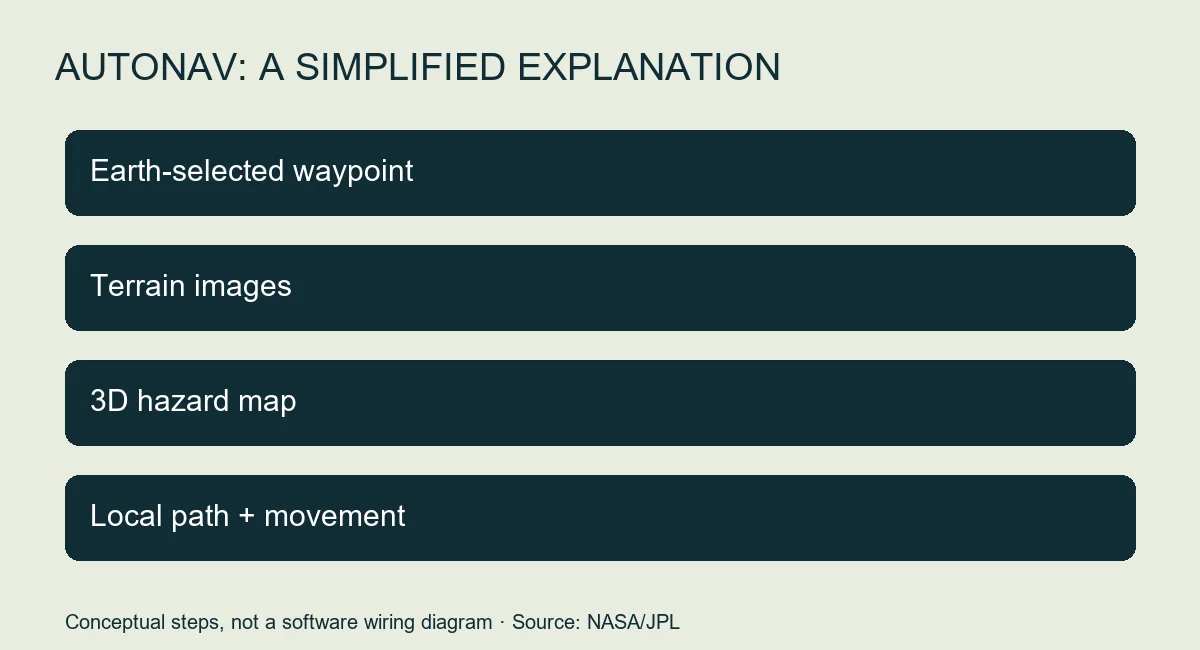
That division of work matters. Selecting a destination and selecting a local path are different decisions. A person can choose where a journey should go while a robot handles some of the immediate movement decisions.
Imagine walking toward a doorway across a room containing chairs. The destination can remain the same while the route changes to avoid a chair. The analogy helps explain local planning. It does not mean a rover sees, reasons or learns exactly as a person does.
Is this the same kind of AI as a chatbot?
Readers should distinguish the task before comparing systems. A chatbot produces language. A navigation system must relate observations to a physical action. The visible outcome is movement, and a mistaken choice can affect a machine in the real world.
The sources checked here describe autonomous navigation. They do not announce a new language model controlling Perseverance. Calling every autonomous system a chatbot would conceal the engineering differences that make the story interesting.
A useful question is: what decisions are delegated, under what constraints, and with what feedback? Those questions reveal more about autonomy than a broad label alone.
Why distance matters for science
Our explanation: Exploration combines travelling and examining. Greater mobility can expand the range of locations available to a science team. It does not make every additional metre equally valuable: a short visit to a revealing outcrop may matter more than a long journey across uninformative ground.
Distance therefore belongs beside scientific context. Ask what observations a drive enabled, whether the material is relevant to the research question, and what uncertainty remains after the measurement. The odometer helps describe progress; it cannot answer those questions by itself.
There is a broader robotics lesson here. Useful autonomy can be narrow and practical. A system does not need to do every part of a mission to make one demanding part of it easier. Clear boundaries make the accomplishment easier to understand and evaluate.
What this milestone does not establish
- A distance record is not proof of life on Mars.
- Autonomous path planning does not mean scientists and operators are unnecessary.
- The cumulative totals are not a controlled comparison of rover speed, safety or efficiency.
- They do not predict how long the rover will keep operating.
We have checked the agency’s reporting, not independently reconstructed its navigation logs. The NASA Science and JPL pages are two publications of the same agency announcement, not two independent measurements.
Quick answers
When did the record happen?
NASA reports 11 October 2026; its announcement is dated 12 October.
How far had Perseverance travelled?
The reported cumulative total was 45.22 kilometres at the milestone.
Is the chart a route map?
No. It compares cumulative distances. It cannot show where the rover travelled.
Sources and transparency
NASA/JPL: original announcement, 12 October · NASA Science: agency publication. Both were opened and checked on 13 October 2026. AI assisted research and writing. Graphics are original explanatory visuals. No photographs, invented tweets or simulated public-post screenshots are used.
What would you like the rover to explore next? Join the moderated discussion ↓