On Saturday, 10 October 2026, Microsoft chairman and CEO Satya Nadella published an essay on X titled "Models as Insider Risks in the Super Intelligence Era". His main point: companies should treat powerful AI models like a new employee with access to sensitive systems. Not because the AI is evil, but because anything that capable can make mistakes or be compromised. He calls for controls that sit outside the AI, a record of everything it does, and an "emergency brake": a person who can pause or stop an AI in the middle of a task. The essay has since been covered by tech outlets worldwide, including in India.
Here is what he actually said, what is new and what isn't, and what it means for any business starting to use AI agents.
What did Satya Nadella say?
Nadella's argument has three parts:
- We can't fully explain why AI models do what they do. With normal software, engineers can trace a behaviour to a specific piece of code. With today's AI models, he writes, that kind of understanding "eludes us". Yet companies are giving these models access to sensitive data and important actions.
- The responsibility stays with the company using the AI. He writes that "a model provider's assurances do not relieve us of that responsibility." In other words, "the AI company said it's safe" is not enough.
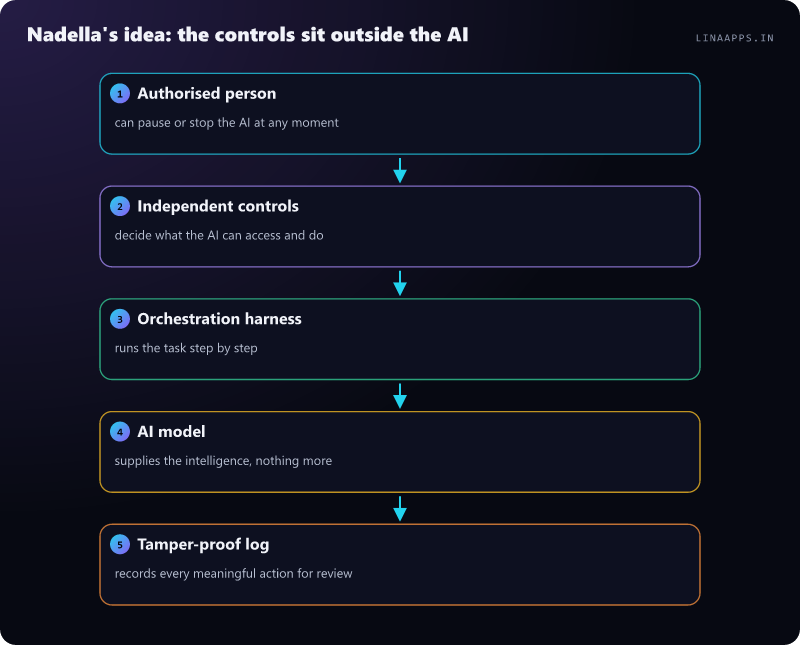
- Treat models like insider risks. Businesses already know how to handle powerful insiders: give them an identity, limit their access, log what they do and set boundaries. Nadella says the same playbook should be applied to AI.
His summary line is short: we need to "separate the supply of intelligence from the authority over it."
The 7 rules Nadella proposes
These are his seven principles, explained in plain words:
- 1Model diversityDon't depend on a single AI model for an important result, and never let a model check its own work
- 2Observe everythingEvery important AI action should leave a tamper-proof record that a person can read
- 3VerifiabilityKeep testing the whole system, including failures, attacks and odd cases, not just the times it works
- 4Independent controlsThe company, not the AI, decides what the AI can access and what it is allowed to do
- 5Independent auditabilityWhatever checks the AI must be separate from the AI being checked
- 6Containment ("emergency brake")Assume the model could be compromised; an authorised person can always pause or stop it mid-task
- 7Incident disclosureWhen something goes wrong, tell the people affected quickly and share the lessons across the industry
What is new, and what is just good practice? The truth behind the headline
| Question | The honest answer |
|---|---|
| Is this a new Microsoft product? | No. It is an essay setting out principles. No new feature, launch date or price was announced in it. |
| Is it a law or an industry standard? | No. Nadella says the industry still needs to create standards where current ones are not enough. |
| Is the "emergency brake" a global AI off-switch? | No. It means a person can pause or stop a specific model during a task inside a company's own systems. |
| Is the idea itself new? | Partly. Limiting access, logging and approvals are old security practices. What's new is the CEO of one of the biggest AI companies saying all AI models should be treated this way. |
| Why does it matter? | It signals where enterprise AI is heading: AI agents with strict controls, logs and human override, not AI left to run on its own. |
What this means for businesses using AI in India
You don't need to be Microsoft to apply this. If your business uses AI chatbots on WhatsApp, AI that updates your CRM, or AI that sends messages to customers, the same rules scale down:
- Give the AI only the access it needs. A support bot should read order status, not your full customer database or bank details.
- Keep a log. Every message the AI sends and every record it changes should be saved where staff can review it.
- A human approves money and promises. Refunds, discounts, payments and anything legal should need a staff member's OK.
- Have a pause button. You should be able to switch the AI off instantly and fall back to staff, without the system breaking.
- Don't let the AI mark its own homework. Spot-check its work with a person or a separate check.
- If it goes wrong, tell customers. Fix it, explain it and learn from it.
Tip: before you add any AI agent to your business, write down three things: what it is allowed to do, what it must never do without a person, and how to switch it off. If a developer can't answer these, the system isn't ready.
Frequently asked questions
What is Satya Nadella's AI "emergency brake"?
It is his principle that an authorised person should always be able to pause or shut down an AI model in the middle of a task. He describes it under "containment", which means assuming a model could be compromised and limiting it from the start.
When and where did Nadella say this?
In an essay titled "Models as Insider Risks in the Super Intelligence Era", published on his X account on 10 October 2026.
Is Microsoft releasing an AI kill switch?
Not in this essay. It sets out principles and calls for industry standards; it doesn't announce a product.
What does "treat AI models as insider risks" mean?
Handle AI the way companies handle powerful employees: limited access, every action logged, independent checks and the ability to stop them. The reason is not that AI is malicious, but that it can make mistakes or be compromised.
Does this apply to small businesses?
Yes, in a simpler form. Limit what your AI can access, log its actions, make a person approve money-related actions, and keep a way to switch it off instantly.
If you want AI in your business with these controls built in
If you're planning an AI feature, such as WhatsApp replies, lead sorting or automatic follow-ups, LINA Apps builds them with limited access, full logs, staff approval for money-related actions and an off switch. Get a project quote, or learn to build AI apps yourself at the LINA Learn workshop.
Sources
- Satya Nadella on X: "Models as Insider Risks in the Super Intelligence Era" (10 October 2026), the original essay, read in full
- Analytics Insight: Satya Nadella says advanced AI models need an emergency brake (11 October 2026)
- NeoTeo: Satya Nadella proposes an emergency brake for AI models (11 October 2026)
- TechBuzz: Nadella calls for AI "emergency brake" under human control (10 October 2026)